Customer Lifetime Value
Know Exactly How Much Each Customer Is Worth
Calculate customer lifetime value automatically. Track LTV by customer type, analyze month-over-month trends, and optimize acquisition spend using LTV metrics.
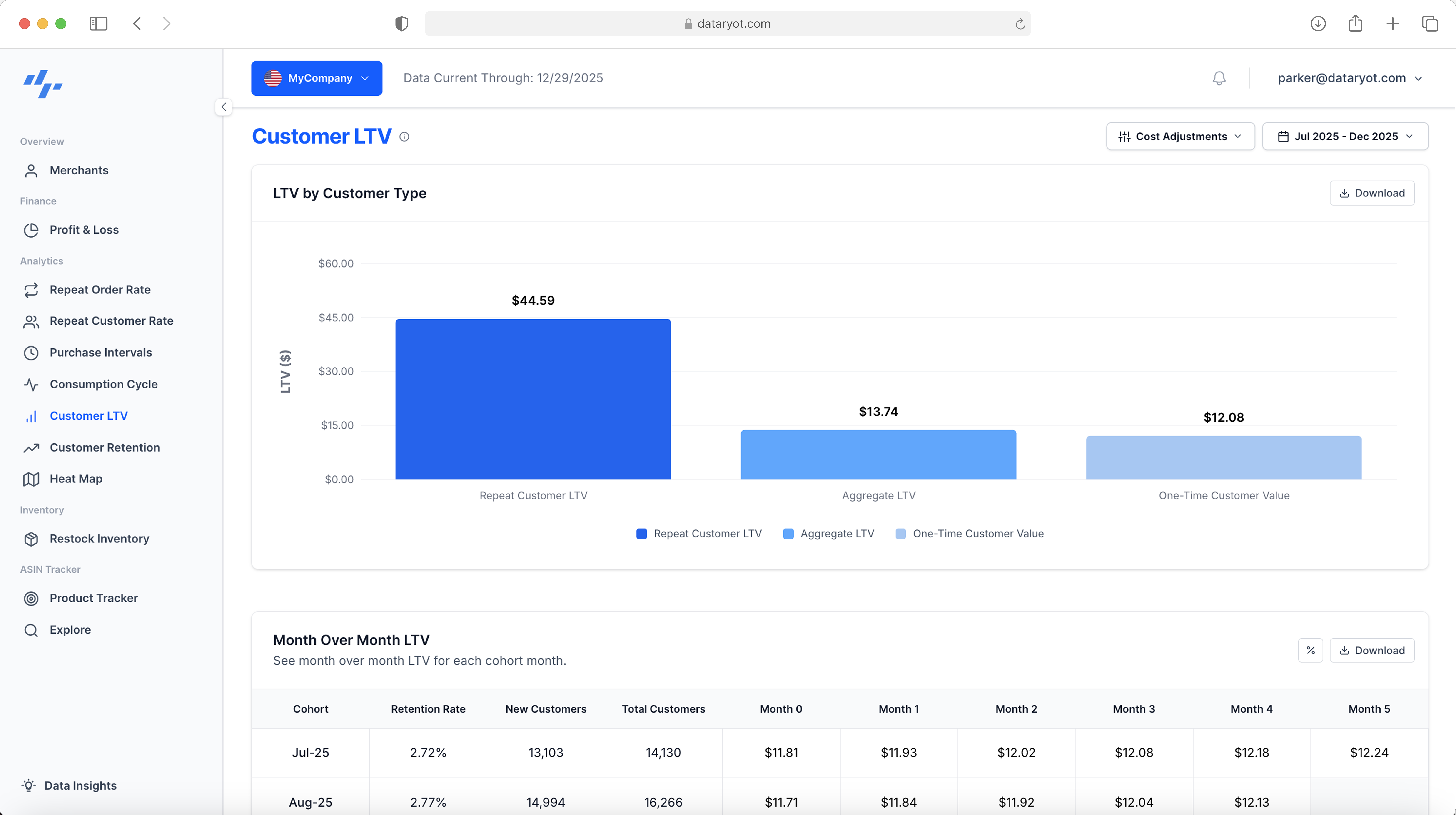
- LTV by Customer Type
- Compare repeat customer LTV, aggregate LTV, and one-time customer value. Clearly see how much loyal customers are worth versus one-time buyers.
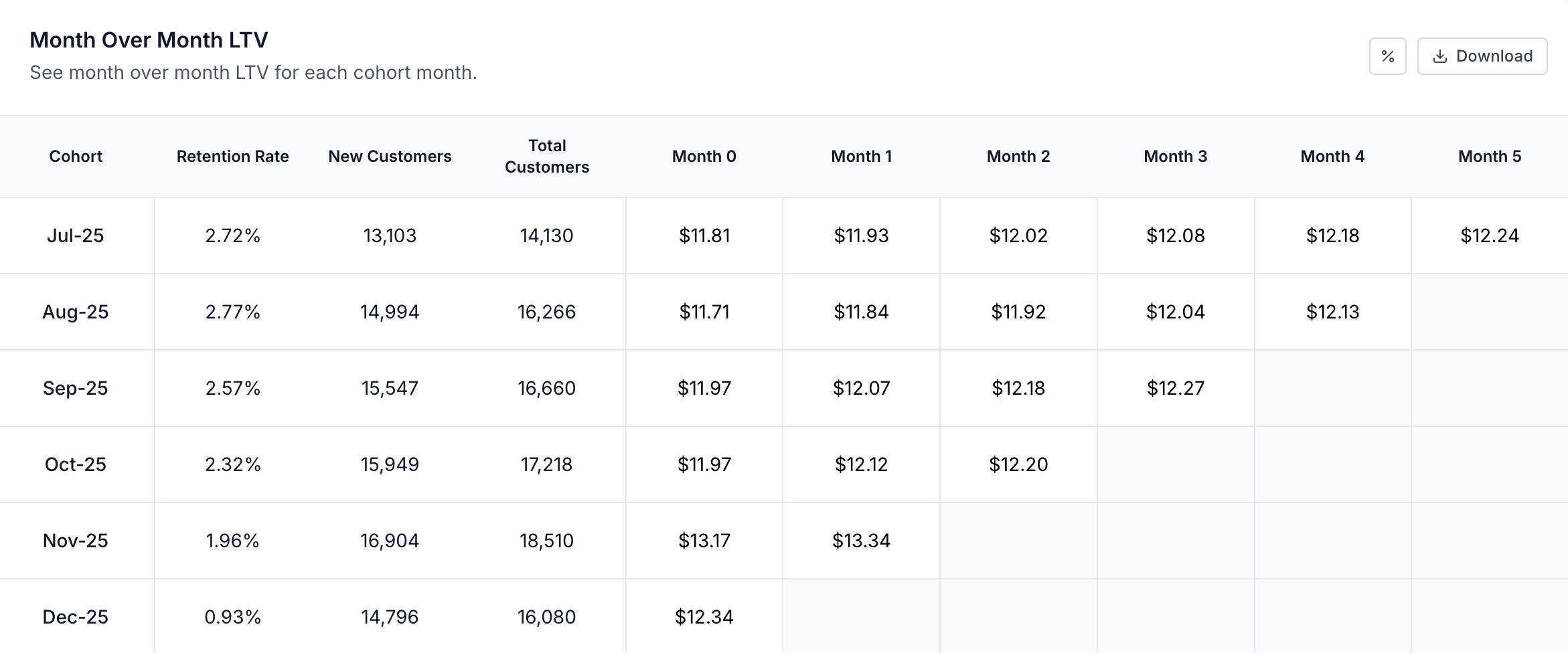
- Month-Over-Month LTV
- Track LTV growth for each customer cohort over time. Monitor retention rates, new customers, and how customer value changes month by month.
- Cost Adjustments
- Calculate net profit–based LTV by applying your operating costs and discounts. Accurately measure true revenue and customer profitability.
Cohort Analysis
Track Customer Value Over Time
Understand how customer value grows across cohorts month by month. Compare retention, customer counts, and cumulative LTV to identify which acquisition periods drive the most long-term value.
Key Insights
Analyze customer lifetime value with clarity and confidence.
- Net Profit-Based LTV
Calculate customer lifetime value using your actual cost structure, including COGS, fees, and marketing spend. Use this to guide smarter acquisition and growth decisions.
- Discount Adjustments
Account for discounts to reflect true realized revenue, not inflated gross sales. Ensure LTV reflects what you actually earn so performance and profitability stay aligned.
- Cohort-Based Analysis
Track customer value by cohort to see how performance evolves over time. Compare retention and LTV growth across cohorts to identify which customers drive long-term value.
Frequently Asked Questions
What is customer lifetime value for Amazon sellers?
Customer lifetime value (LTV) for Amazon sellers is the total revenue a customer generates over their entire relationship with your brand. It includes all orders, repeat purchases, and products they buy from you.
How do you calculate Amazon customer LTV?
Calculate Amazon LTV by dividing total customer sales by the number of customers. For repeat customers, it's total repeat customer sales divided by repeat customers. For one-time customers, it's total one-time customer sales divided by one-time customers.
What is the difference between Repeat Customer LTV and Aggregate LTV?
Repeat Customer LTV is the average lifetime value of customers who made multiple purchases. Aggregate LTV is the average lifetime value of all customers (both one-time and repeat). Aggregate LTV gives you the overall customer value, while Repeat Customer LTV shows the value of your loyal customers.
How can I use cost adjustments to calculate net profit-based LTV?
Enter your cost percentages (COGS, Referral Fee, FBA Fee, Marketing, and Other Misc) in the Cost Adjustments settings. All LTV values will be adjusted using the formula: 1 - (COGS + Referral + FBA + Marketing + Misc Fees) / 100. This gives you a net profit-based LTV that reflects the true value of your customers after all costs.
What is Month Over Month LTV and how is it calculated?
Month Over Month LTV tracks how customer value changes over time for each cohort. Each month shows the total sales from that cohort through that month, divided by the number of customers in the cohort. This helps you see how customer value grows over time.
Start tracking customer lifetime value today
Calculate LTV by customer type and optimize acquisition spend with net profit-based metrics.